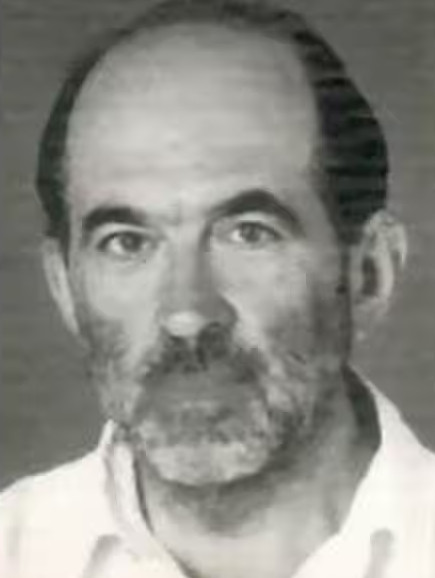
Published: October 2025
Keywords:
Love, psychoanalysis, poetry, George Seferis, speech / naming, truth, therapeutic dialogue, freedom, dwelling in names, light and darkness, Antigone, experience / bliss, the ineffable / the unspeakable.
Kostas Gemenetzis
(by Anastasia Geitsidou).
On his personal website (https://sites.google.com/view/gemenetzis) he wrote:
Once when I needed to write a biography, I started with the phrase "Kostas Gemenetzis was born in 1944..." and it immediately occurred to me to continue: "...and he died...".
Even as a child, a question arose with my name. People would turn to me and call me "Kostas...", "Little Kostas...", "Gemenetzis...". At some point, I asked myself: Am I, allover, contained in my name? My answer was clear: No! Those who speak to me, they address me. And, if "Kostas" does not cover "me", does the ant-onym "me" have a name, instead of which it is said? My answer was once again clear: No!
Many years later I saw, with relief, that I was not alone in my question. Somewhere in Kierkegaard I read: You stick your finger in the ground to smell what country you are in, I stick my finger into existence - it smells of nothing. The question had begun to quiet down and give way to the acceptance of a light "nothing", which pictures my Ego much more than any name; acceptance of a light "nothing", which accompanies my name, removes all absoluteness from it, leaves it in the cradle of its transience, and to every "I was born" dictates the "I died".
These were to mark my evolution, among others as a therapist.
Let everything I did and everything I did not do be seen in this light.
Kostas Gemenetzis was born in Thessaloniki in 1944. His parents were refugees from Eastern Thrace. He was the eldest of two children. He studied Medicine at the Aristotle University of Thessaloniki. A few years later he first came into contact with Daseinanalyse, the Phenomenological Existential Analysis. He studied Philosophy and Psychology at the University of Tübingen in the then Federal Republic of Germany with a DAAD scholarship. He worked in Switzerland in a psychiatric hospital and in psychiatric clinics. There he trained for 10 years in psychoanalysis at the Institute of Daseinsanalyse with Medard Boss, Gion Condrau, Hanspeter Padrutt, etc. and then worked as a psychoanalyst. In 1984 he returned to Greece and worked as a psychoanalyst in Athens. In 2000 he returned to Thessaloniki, where he continued to work as a psychoanalyst. His approach to psychoanalysis was existential and phenomenological: he did not focus only on "diagnosis" and "treatment" in terms of pathology, but on the "encounter" and the "meaningful opening" of human experience. In 2003, the Hellenic Society of Phenomenological - Existential Analysis and Psychotherapy was founded, of which he was a founding member and president. He then served as president of IFDA (International Federation of Daseinsanalytic Societies). He had a rich writing, translation, teaching and supervisory work. He came into contact with and studied in depth the work of scientists, philosophers and poets: Freud, Heidegger, Hölderlin, Descartes, Husserl, Parmenides, Heraclitus, Georg Trakl, Paul Celan, Thrasyvoulos Georgiadis, Wittgenstein, Zen philosophy, Byung-Chul Han, Baudrillard, Anne Carson. Consequently, his theoretical work connects philosophical currents (e.g. Heidegger, Husserl) with clinical practice.
Among his works are “The Letter A” — an introduction to the world of the therapeutic encounter, “Reintroduction to Psychoanalysis”, “The Dream – a Psychoanalytic Approach to Dreams” . Many of his texts are freely available online.
In January 2024, he suffered an episode of intracerebral hemorrhage. However, he continued his therapeutic and teaching activity via the Internet until his death in August 2025.
The following excerpt is quoted from his personal website:
I saw much. The vision met in all the ethers.
I took in much. Noises of the cities, at night, and in the sun and always.
I knew much. The pauses of life. - Oh Noises and Visions!
Departure in tenderness and in new noises!
Arthur Rimbaud, Départ [Departure]
https://sites.google.com/view/gemenetzis/
Abstract
(by Anastasia Geitsidou).
In his talk “When the Poet Teaches the Psychoanalyst Love”, Kostas Gemenetzis explores the relationship between psychoanalysis, poetry, and the notion of love, drawing inspiration from the poetic language of George Seferis. He begins by questioning whether love can truly be considered a concept or an emotion, noting that in psychoanalytic practice, love cannot be confined to such definitions.
The phrase “Love is love” serves as a guiding motif — a tautology that exposes language’s inability to grasp the essence of love, which transcends theoretical, emotional, or relational frameworks.
Gemenetzis argues that the psychoanalyst, much like the poet, must abandon interpretive tools and surrender to the truth of language, where love can be both spoken and understood.
Seferis’s poetry — especially Kíhli — offers an example of this pure speech of love that “inhabits” light and language, yet simultaneously contains darkness and death. The poet, “condemned to truth,” becomes a teacher to the psychoanalyst, showing that love is not a human possession but a cosmic force, “the serene house of man.”
Thus, love cannot be analyzed; it must be named, inhabited, and experienced — it is the truth spoken “on pain of death.”