Published: March 2025
Keywords:
Jaakko Seikkula, Laboratory of Applied Psychology, AUTH, Embodied Aspects of psychotherapy’s process, Open Dialogue, Mikhail Bakhtin, Dialogic Practice, Polyphonic Dialogues, Voices, Network, Family, Context, Emotional Experience, Present Moment, Relational Mind, Polyphonic Self, Affect, Body, Embodied Expression, Psychotic Crisis, Psychotic Behaviour, Ways and Resources of Survival, Reflexivity.
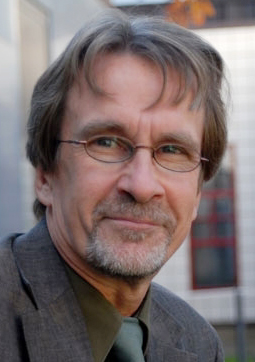
Jaakko Seikkula
Ph.D. is a senior faculty member of the Institute for Dialogic Practice and a Professor of Psychotherapy at the University of Jyvaskyla, Finland.
Amateur video recording of Jaakko Seikkula's speech: “Open Dialogue is an embodied practice” at the event "Embodied aspects of psychotherapy's process", organised by the Laboratory of Applied Psychology, Psychology Dept., AUTH, April 2024.
In this presentation, Jaakko Seikkula looks back at Open Dialogue, the main ideas that influenced its development, Psychoanalysis, Systemic Thinking, Social Constructionism and the shift to language, Narratives to reach the present day that focuses on feelings and their sharing, the emotional and embodied experience taking place in open, collaborative, polyphonic network meetings.
Translation by hearing, subtitling and videoAbstract editing: Fany Triantafillou.
As a summary, we present the content of three slides from Jaakko’s speech.
A) Τhe basic ideas of the Dialogical Practice as described in the new book of Jaakko Seikkula: Dialogic cures – why?
1) Dialogic practice creates a new human view, in which the best mental health care is to accept people's emotional experiences instead of aiming at eliminating mental symptoms or changing the family.
2) Dialogic practice adopts and utilises the latest intersubjective knowledge that a person is an active participant in embodied rhythmic interaction from birth. Reality always arises in a relationship. The management of severe mental health crises takes into account the person as a full bodily participant in a constantly ongoing stream of interaction and dialogue. Baby is an active author of her own growth. In the very same way, every person in need of help is an active author of her/his help.
3) Open dialogues have developed as one form of family therapeutic work but the aim is no longer to make an intervention to change the family system but to create a shared experience in which a new language is created for managing the most difficult experiences. Families are not objects of care but invaluable partners for professionals.
4) The dialogical practice utilises the knowledge that the human mind is constructed as a bodily process that allows the human being to be considered as a whole and thus transcends the dualistic conception of man. The Relational Mind. Reality is contextual, arising in each situation. A holistic bodily understanding makes psychotherapy possible much more widely than before because no special inner linguistic insight is needed as a precondition, and the sharing of emotions is already healing.
5) Dialogical practice makes it possible to understand psychotic behaviour as a necessary human response to extreme stress. Psychosis is not a psychopathological condition or illness, but a person has a lot of own resources to cope with a crisis. In this way, it has been possible to drastically reduce the use of neuroleptic medication and prevent the harmful side effects of medication.
6) Dialogue improves reflectivity. Dialogue orientation has created ways to determine the quality of dialogue (DIHC method). Healing dialogues can be explored, and the best possible ways to help another and thus develop a conversation that supports clients' own reflections.
7) Open dialogues are based on systematic scientific research in everyday clinical practice as naturalistic research settings. The task of scientific research is to develop a practice that helps people on a broad scale, exploring both treatment outcomes and processes of dialogues. I am not familiar with any psychiatric treatment model that has been so extensively scientifically researched.
B) Meaning is embodied and relational – moving as the first language.
In the most fundamental sense, one body understands the other body to the degree it not only resembles that body but moves and gestures or has the possibility of moving and gesturing in ways similar to the ways (…) in which that, body moves and gestures, has perceptual experience similar to that body, perceptual experience that consistently combine certain tactile-kinetic/affective feelings with certain contextually situated kinetic – visual awareness. Meaning is thus in the most fundamental way, dynamically constructed: it is articulated along the lines of moving body.
(Maxine Sheet-Johnstone, 2009, p. 355).
C) Polyphonic Self
"Voices are the speaking personality, the speaking consciousness". (Bakhtin, 1984; Wertsch, 1990).
"Voices are traces and they are activated by new events that are similar or related to the original event" (Stiles et al., 2004).
"When the mind is thinking, it is simply talking to itself, asking questions and answering them, and saying yes or no" (Plato, Theaetetus, 189e-190a).